By: Bangkit Rahmat Tri Widodo
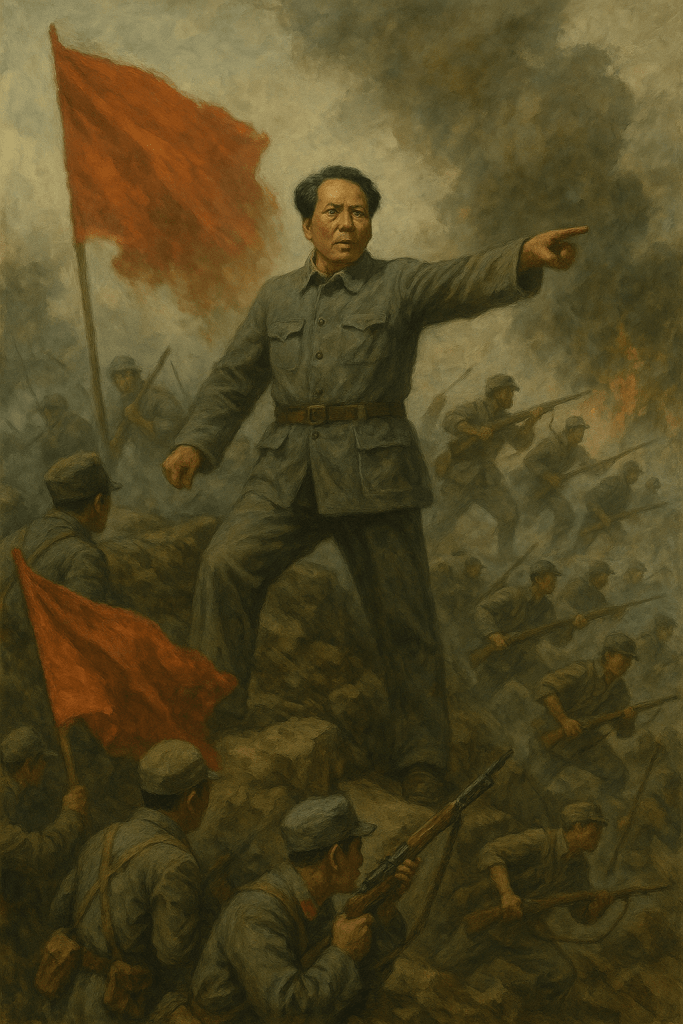
Mao Zedong’s theory of revolutionary warfare represents one of the essential foundations of modern military thought, particularly in relation to the concept of guerrilla warfare and the struggle of the people against stronger state powers. Within the tradition of strategic thinking, Mao’s ideas occupy a distinctive position because they do not merely formulate tactical-military aspects but also integrate political, social, and ideological dimensions into a unified framework of struggle. War, therefore, is not perceived solely as an armed clash, but as the continuation of politics by other means—consistent with Clausewitzian principles, yet with a more radical emphasis on mass mobilization and social transformation as the basis of revolutionary power (Clausewitz, 1976; Mao, 1961/2015).
As the leader of the Chinese Revolution, Mao developed a systematic approach by which relatively weaker revolutionary groups could overcome stronger state powers through mass support, protracted warfare, and tactical flexibility. His strategy became known as the Three Stages of Revolutionary Warfare: the stage of organization and mobilization, the stage of guerrilla warfare, and the stage of conventional warfare. This model is both progressive and adaptive, with each stage marking the transition from a primarily political phase to an increasingly mature military phase, highly contingent upon prevailing socio-political conditions (Griffith, 1961; Sawyer, 1994).
Historically, this theory proved decisive in the Chinese Communist Party’s victory during the Civil War against the Kuomintang. Yet its influence extended far beyond China, inspiring revolutionary movements across Asia, Africa, and Latin America throughout the twentieth century. The Viet Cong in Vietnam, the Khmer Rouge in Cambodia, and numerous Latin American guerrilla movements adapted Mao’s principles to local contexts, thereby demonstrating the universal character of the three-stage framework (Selden, 1995; Wickham-Crowley, 1992).
The relevance of Mao’s theory did not end with the classical revolutionary era. In modern insurgency literature, thinkers such as David Galula and David Kilcullen developed counterinsurgency doctrines that resonate with the essence of Mao’s ideas: the success of both insurgency and counterinsurgency is determined by the ability to secure and mobilize civilian support. The widely known principle of “winning hearts and minds” in counterinsurgency reflects precisely the importance of a social base, as emphasized by Mao in the first stage of revolution (Galula, 1964; Kilcullen, 2009).
Furthermore, the transformation of contemporary conflict toward hybrid warfare and gray-zone confrontation demonstrates that Mao’s insights retain strong analytical relevance. The asymmetric strategies employed by Russia in the Ukraine conflict, as well as by the Taliban and ISIS in their confrontations with militarily superior state powers, embody Maoist logic: enduring weakness, gradually eroding adversaries through indirect operations, and ultimately striving to create conditions for open confrontation (Hoffman, 2007; Byman, 2020). In this sense, Mao’s model can be regarded as a precursor to the modern concept of hybrid warfare, in which both state and non-state actors employ a simultaneous integration of military, political, economic, and informational instruments to achieve strategic objectives.
For Indonesia, an understanding of Mao’s framework remains highly relevant. The country’s archipelagic geography and social diversity carry inherent vulnerabilities to insurgency, separatism, and terrorism. An academic analysis of Mao’s three stages of revolutionary warfare provides important insights for formulating defense strategies that are responsive to non-conventional threats, while also serving as a conceptual foundation for addressing evolving forms of asymmetric conflict. Thus, the study of Mao’s theory is not merely a historical exercise but a strategic contribution to the development of contemporary military doctrine and defense policy.
Stage One: Organization and Mobilization
The initial stage in Mao’s strategy represents a foundational phase that determines the success of subsequent stages. At this point, the primary objective is not direct military confrontation but rather the establishment of a robust ideological, social, and political base in rural areas. Mao began from the conviction that revolutionary power could only endure and expand if it was firmly rooted in the people. Therefore, mass support was not regarded as an auxiliary element, but as the very core of revolutionary strength (Mao, 1961/2015).
The implementation of this strategy was achieved through political education, aimed at building collective awareness among the people regarding social injustice and the necessity of revolution. Such education was not conducted merely in a top-down manner but also integrated the concrete experiences of peasants and workers, thereby making them feel like active participants in the struggle (Fairbank & Feuerwerker, 1986).
In addition, the recruitment of militant cadres led to the formation of organizational cells at the village level. These cells had dual functions: serving both as agents of propaganda and mobilization, and as embryonic structures of revolutionary military organization. In the agrarian context, land reform campaigns were among the most effective instruments for winning peasant sympathy. The redistribution of land not only undermined the social base of the landlord classes aligned with the old regime but also fostered trust and moral legitimacy for the revolutionary movement (Selden, 1995).
Another step was the infiltration of local government structures in order to undermine state legitimacy from within. Through such infiltration, the revolutionary movement aimed to create a vacuum of state authority at the grassroots level, while simultaneously presenting an alternative revolutionary authority that appeared more responsive to the people’s needs. Thus, at this stage, Mao emphasized that war was essentially politics by other means, with military success dependent upon broad political legitimacy and social support.
Stage Two: Guerrilla Warfare
Once a social and political base had been established, the revolution advanced to the second stage: guerrilla warfare. At this point, revolutionary forces began to employ military instruments in a limited capacity to challenge the ruling regime. However, the purpose of guerrilla warfare was not to annihilate the enemy outright, but to erode its strength gradually while simultaneously expanding revolutionary influence.
The central characteristics of guerrilla warfare included high mobility, tactical flexibility, and effective exploitation of geography. Guerrilla units carried out small, rapid, and surprising attacks against vulnerable targets such as isolated military outposts, communication lines, or enemy supply routes. Through such methods, revolutionary forces could avoid frontal engagements that would almost certainly favor the militarily superior adversary (Galula, 1964).
Mao emphasized the importance of the “hit-and-run” strategy, enabling small forces to move quickly, attack, and then retreat before the enemy could consolidate. Here, time became the principal weapon: the insurgents did not seek to win large-scale battles quickly but instead prolonged the conflict until the enemy was depleted of energy, resources, and legitimacy (Mao, 1961/2015). In this way, weaker revolutionary forces could survive while simultaneously expanding their influence, creating an asymmetric dynamic unfavorable to the adversary.
Stage Three: Conventional Warfare
If the first two stages succeeded in consolidating political strength and steadily eroding the enemy’s military capacity, the revolution then entered its final stage: open conventional warfare. At this stage, the revolutionary forces had evolved into a well-organized military institution with a more formal structure, secure base areas, and widespread popular support. These conditions enabled the revolution to transition from guerrilla tactics to frontal confrontation.
In this phase, revolutionary forces typically controlled “liberated zones” functioning as logistical, training, and command centers. Popular support evolved from passive sympathy into active contributions, manifesting in the form of labor, supplies, and political legitimacy. Meanwhile, government forces often experienced material and moral exhaustion, which significantly weakened their position (Snow, 1968).
Large-scale battles were then fought with the objective of capturing major cities and government centers. This process marked the climax of the revolution, wherein once inferior forces were able to overthrow the old regime and replace it with a new revolutionary government. Thus, the third stage represented the complete integration of political, military, and social dimensions that Mao had envisioned from the outset of his revolutionary warfare strategy.
Conceptual Framework of Comparison
Mao Zedong’s theory of revolutionary warfare, with its three-stage approach, represents a crucial analytical cornerstone for understanding the dynamics of asymmetric conflict. To assess its relevance and transformation, however, this theory must be examined in comparison with modern insurgency doctrines and the concept of hybrid warfare that has developed in the twenty-first century.
At the outset, Mao’s three stages emphasize that the success of a revolution is not determined solely by military power but rather by the strength of its social and political base. The stage of organization and mobilization, which stresses recruitment, political education, and the formation of underground structures, aligns with what David Galula (1964) later highlighted in his counterinsurgency doctrine. Galula argued that the essence of insurgency lies in securing popular support, while the essence of counterinsurgency lies in reclaiming the “hearts and minds” of the people. In other words, Mao’s focus on the people as the center of gravity strongly resonates with modern counterinsurgency doctrine, differing only in orientation: Mao sought to overthrow the state, while Galula sought to defend it.
In Mao’s second stage of guerrilla warfare, the emphasis on small-scale attacks, high mobility, and the use of geography to counter stronger adversaries closely resembles the observations of David Kilcullen (2009). Kilcullen emphasized that modern insurgencies are complex, decentralized, and networked, where small-scale operations often prove more decisive than significant conventional battles. In this context, Mao’s strategy of “time as a weapon” remains relevant: insurgents do not seek swift victories but instead wear down their adversaries gradually until exhaustion sets in.
Mao’s final stage, open conventional warfare, can be understood as the transition point when an insurgency has matured. Yet in contemporary settings, this transition is not always linear. The concept of hybrid warfare, introduced by Frank Hoffman (2007) and further popularized through Russia’s Gerasimov Doctrine, demonstrates that modern actors do not necessarily wait until they are strong enough to shift into conventional conflict. Instead, they employ a simultaneous combination of open military operations, information warfare, cyberattacks, economic measures, and the use of non-state actors to achieve strategic objectives. This represents a modification of Mao’s logic: whereas Mao stressed sequential progression, hybrid warfare emphasizes the simultaneous integration of diverse instruments of power.
Thus, it can be concluded that Mao’s three stages provide a foundational framework for understanding insurgency, while modern counterinsurgency doctrines emphasize the importance of addressing its social and political dimensions, and the concept of hybrid warfare demonstrates how Maoist logic has evolved into a more complex and multidimensional form. In the Indonesian context, an integrative understanding of all three can enrich national defense doctrine, particularly in addressing asymmetric conflict, separatism, terrorism, and information warfare—threats that are increasingly relevant in the strategic environment of the Indo-Pacific.
Contemporary Applications
Mao Zedong’s three-stage model has proven to be not only the framework of the Chinese revolution but also a recurring strategic pattern in numerous contemporary conflicts. In Vietnam, for instance, Mao’s strategy was directly adapted by the Viet Minh and later the Viet Cong. The first stage was realized through political mobilization of the peasantry and the construction of ideological bases in rural areas. The second stage manifested in guerrilla warfare against French and later American forces, utilizing the jungle terrain and swift raids to weaken enemy logistics. The third stage was exemplified by major offensives such as the Tet Offensive of 1968, which, although not a complete military victory, succeeded in shaking the political legitimacy of the United States. The Vietnamese case demonstrates that Mao’s strategy can function effectively when supported by favorable social, geographic, and international conditions.
In contrast, the experience of the FARC in Colombia highlights the limitations of Mao’s model. Since the 1960s, FARC sought to establish rural bases through ideological propaganda and agrarian reform in the Maoist tradition. They engaged in long-term guerrilla warfare, targeting military posts and state infrastructure. However, unlike in China or Vietnam, FARC failed to transition into the third stage of open conventional warfare. Constraints included limited international support, the consolidation of the Colombian state with U.S. assistance, and internal fragmentation. This case suggests that Mao’s logic is only effective when supported by broad political legitimacy and when sufficient strategic space exists to facilitate a transition into conventional warfare.
The Taliban in Afghanistan provides another example of Mao’s continued relevance. After being ousted in 2001, the Taliban returned to rural areas, rebuilding ideological networks through religious education and social patronage, consistent with Mao’s first stage. They then conducted guerrilla warfare against NATO and Afghan government forces, steadily depleting enemy resources. With nearly two decades of strategic patience, the Taliban ultimately recaptured Kabul in 2021. Here, Mao’s principle that “time is a weapon” proved highly relevant: small forces can survive, expand, and eventually prevail over stronger adversaries, provided they possess political resilience and social support.
By contrast, ISIS in Iraq and Syria represents a departure from Mao’s framework. Although they began with ideological mobilization and propaganda, they bypassed the guerrilla stage, rapidly shifting toward conventional warfare and establishing a proto-state. Their seizure of Mosul and Raqqa in 2014 appeared to replicate Mao’s third stage in accelerated form. Yet this rapid success revealed significant weaknesses: the absence of a solid social base and stable political legitimacy. As a result, ISIS quickly lost territory under international military pressure. This case illustrates that skipping Mao’s early stages—particularly the emphasis on mass support—can critically undermine the durability of a revolutionary movement.
Taken together, these four cases show that Mao’s framework retains strong analytical utility. Vietnam demonstrated the full effectiveness of the three-stage model; Colombia revealed its limitations; the Taliban confirmed the relevance of protracted war; and ISIS highlighted the risks of disregarding sequential progression. Despite differences in ideology, geography, and geopolitics, Mao’s model remains a key reference for understanding insurgency dynamics and asymmetric warfare.
For Indonesia, the lessons are clear. First, popular support constitutes the core of defense resilience, making counterinsurgency strategies ineffective if limited solely to military operations without building political legitimacy, social development, and public welfare. Second, modern conflicts no longer unfold linearly as envisioned by Mao but often combine elements of guerrilla warfare, politics, information operations, and even cyber warfare, as seen in contemporary hybrid conflicts. Thus, understanding Mao’s three stages remains essential—not for ideological replication but for anticipating evolving forms of non-conventional and asymmetric threats in the Indo-Pacific strategic environment.
Conclusion
Mao Zedong’s theory of revolutionary warfare, with its three-stage framework, underscores that war is not merely a matter of military affairs, but equally political, social, and ideological. Mao placed the people at the center of gravity of revolution, such that military power could only develop when supported by strong political legitimacy and a solid social foundation. This framework proved effective during the Chinese Revolution and subsequently inspired various armed movements in Vietnam, Cambodia, and Latin America. Furthermore, Mao’s theory has become a critical reference point in modern insurgency literature, where thinkers such as Galula and Kilcullen have emphasized similar principles from a counterinsurgency perspective: without popular support, no insurgency can endure, yet without political legitimacy, no state can prevail in the fight against insurgency (Galula, 1964; Kilcullen, 2009).
In contemporary military discourse, the relevance of Mao’s theory can be analyzed through the lenses of small wars and hybrid warfare. Small wars highlight the importance of non-conventional operations conducted by weaker actors against stronger state powers, a direct legacy of Mao’s framework. Meanwhile, the concept of hybrid warfare, developed by Hoffman (2007) and later expanded through Russia’s Gerasimov Doctrine, demonstrates that modern conflicts no longer unfold sequentially as in Mao’s model, but rather through the simultaneous integration of military, political, economic, informational, and even cyber dimensions. In other words, whereas Mao emphasized progression from weakness to strength, hybrid warfare stresses the concurrent employment of diverse instruments of power to generate asymmetric strategic effects.
Mao’s theory thus occupies a foundational position in the literature on modern warfare, serving not merely as a doctrine of communist revolution but as a universal analytical framework that explains why weaker actors can endure against stronger powers, how insurgencies evolve, and what factors determine their success or failure. Yet, in the contemporary context, Mao’s framework must be read critically: today’s conflicts extend beyond guerrilla and conventional warfare to encompass multidimensional struggles in the domains of information, cyberspace, and global public opinion.
For Indonesia, academic reflection on Mao’s theory carries strategic significance. As an archipelagic state with profound social diversity, the threats of insurgency, separatism, and terrorism remain central concerns in defense planning. Studying Mao’s model offers valuable insights into how conflicts may evolve from social mobilization to military confrontation, while also underscoring that political legitimacy and public welfare are key to preventing asymmetric conflict. At the same time, an understanding of hybrid warfare broadens the perspective of the Indonesian Armed Forces (TNI), enabling anticipation of future wars of greater complexity, where information, cyber, and diplomacy play roles equal to conventional military force.
Accordingly, Mao’s Three Stages of Revolutionary Warfare should be regarded not merely as a historical doctrine but as a theoretical foundation that bridges classical studies of war with modern defense strategy. Integrating Mao’s insights with the literature on insurgency, small wars, and hybrid warfare enables the TNI to develop doctrines that are more adaptive, responsive, and relevant to the dynamic strategic environment of the Indo-Pacific.
References
Byman, D. (2020). Road warriors: Foreign fighters in the armies of jihad. Oxford University Press.
Clausewitz, C. von. (1976). On war (M. Howard & P. Paret, Eds. and Trans.). Princeton University Press. (Original work published 1832)
Fairbank, J. K., & Feuerwerker, A. (Eds.). (1986). The Cambridge history of China: Republican China 1912–1949, Part 1. Cambridge University Press.
Galula, D. (1964). Counterinsurgency warfare: Theory and practice. Praeger.
Giustozzi, A. (2019). The Taliban at war, 2001–2018. Oxford University Press.
Griffith, S. B. (1961). Mao Tse-tung on guerrilla warfare. Praeger.
Hoffman, F. G. (2007). Conflict in the 21st century: The rise of hybrid wars. Potomac Institute for Policy Studies.
Kilcullen, D. (2009). The accidental guerrilla: Fighting small wars in the midst of a big one. Oxford University Press.
Kolko, G. (1994). Anatomy of a war: Vietnam, the United States, and the modern historical experience. The New Press.
Leech, G. (2011). The FARC: The longest insurgency. Zed Books.
Lister, C. (2015). The Islamic State: A brief introduction. Brookings Institution Press.
Mao, Z. (2015). On guerrilla warfare (S. B. Griffith, Trans.). Dover Publications. (Original work published 1937)
Sawyer, R. D. (1994). The seven military classics of ancient China. Basic Books.
Selden, M. (1995). China in revolution: The Yenan way revisited. M. E. Sharpe.
Snow, E. (1968). Red star over China. Grove Press.
Truong, N. (1985). Vietnamese revolutionary warfare. Ministry of National Defense.
Wickham-Crowley, T. (1992). Guerrillas and revolution in Latin America: A comparative study of insurgents and regimes since 1956. Princeton University Press.
 Pemikiran Kebangsaan
Leave a comment