By: Bangkit Rahmat Tri Widodo
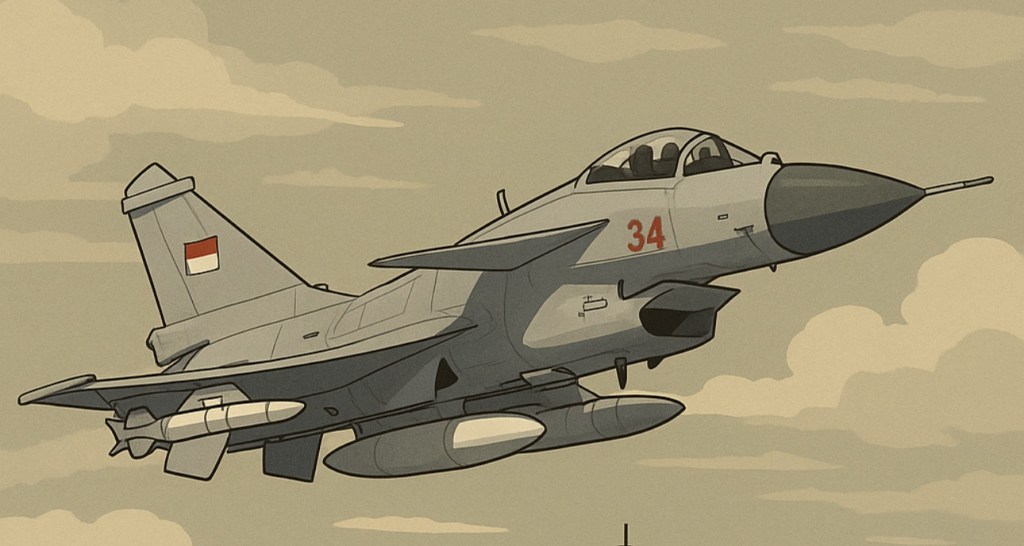
Indonesia’s decision to procure the Chengdu J-10 multirole fighter jet from China signifies more than a routine arms acquisition; it marks a turning point in the evolution of Indonesia’s strategic identity and defense modernization. The move encapsulates the ongoing transformation of the Indonesian National Armed Forces (TNI) in navigating the dual imperatives of capability enhancement and strategic autonomy. Amid intensifying great-power competition and rapid technological shifts, the procurement reflects Indonesia’s persistent quest to balance external engagement with internal resilience, a manifestation of its long-standing doctrine of politik luar negeri bebas-aktif (independent and active foreign policy).
At one level, the J-10 program responds to operational necessity. Indonesia’s archipelagic geography demands a credible, agile, and sustainable airpower capability to safeguard territorial sovereignty across vast maritime zones. The TNI Air Force (TNI AU), long reliant on aging platforms from multiple suppliers, faces a pressing need to renew its inventory and improve its deterrence posture. Yet, at a deeper level, the acquisition represents a nuanced strategic statement: Indonesia’s commitment to pluralizing its defense partnerships while asserting an independent trajectory in the Indo-Pacific security order.
Strategic Context: Indonesia in a Shifting Indo-Pacific Landscape
The Indo-Pacific has entered an era of renewed contestation. The resurgence of U.S.–China rivalry, maritime disputes in the South China Sea, and the proliferation of defense technologies have collectively redrawn the strategic map of Asia. For Southeast Asian nations, this competition imposes structural pressures to choose sides or, at the very least, define clear strategic postures. Indonesia, the region’s largest state and a self-proclaimed maritime fulcrum, has opted for a third path, strategic equilibrium through diversified engagement.
This approach echoes what contemporary scholars define as strategic hedging: maintaining cooperative ties with all major powers while avoiding dependency on any single one (Kuik, 2008). For Indonesia, hedging is not a reactive stance but an expression of agency, leveraging relationships with multiple defense partners to expand technological access, political flexibility, and strategic depth. The J-10 acquisition thus complements Indonesia’s broader diversification pattern, which includes collaboration with the United States (F-16 upgrades), South Korea (KF-21 co-development), and Europe (air transport and radar systems).
Indonesia’s defense policy under this configuration seeks to balance hard power with diplomatic prudence. The introduction of the J-10 platform, an advanced multirole fighter equipped with modern avionics and beyond-visual-range capabilities, reinforces deterrence while maintaining non-alignment. It allows Indonesia to project an image of modernization without provocation, demonstrating that sovereignty and restraint can coexist within a coherent defense doctrine.
The Institutional Logic: The Nusantara Defense Period
The J-10 acquisition aligns with what Indonesian defense thinkers describe as the Nusantara Defense Period, a conceptual era linking defense modernization to national development and technological self-reliance. This vision integrates three dimensions: modernization of platforms and doctrines, localization of industrial participation, and moralization of military professionalism.
Modernization entails revitalizing the TNI’s capability through new-generation systems that support joint operations and digitalized command structures. The J-10 fits this blueprint as a versatile, networked aircraft capable of supporting maritime defense and regional surveillance missions. Localization emphasizes the integration of domestic industries such as PT Dirgantara Indonesia (PTDI) within global supply chains through offset programs, co-production, and maintenance partnerships. By embedding industrial collaboration into procurement, Indonesia seeks to convert defense spending into long-term technological dividends (Bitzinger, 2016).
The third dimension, moralization, reflects the ethical renewal of the TNI as a professional and accountable force. Defense modernization is not merely about platforms but also about integrity, transparency, and moral discipline. Public scrutiny over procurement has increased since the post-1998 reforms, and democratic oversight mechanisms, parliamentary review, audit institutions, and public disclosure, now form part of defense governance. The J-10 procurement, therefore, is also a test of institutional credibility: whether modernization can proceed efficiently, ethically, and transparently within a democratic framework (Aspinall & Mietzner, 2022).
Airpower and National Sovereignty
For an archipelagic state, airpower is both the first line of defense and the symbol of technological civilization. Indonesia’s historical experience has shown that maritime defense without air superiority is inherently incomplete. The TNI AU’s modernization, therefore, carries implications not only for military readiness but also for national unity. Airpower connects islands, projects sovereignty, and reinforces national confidence in the state’s capacity to defend its territory.
The introduction of the J-10 enhances Indonesia’s deterrence in critical air corridors such as the Natuna Sea and the Malacca–Sunda–Lombok straits. These routes are vital to both national security and global commerce. The aircraft’s multirole capability allows for flexible operations, air defense, interception, and limited strike, thereby providing a scalable response to both traditional and non-traditional security threats. In practical terms, the modernization increases Indonesia’s ability to respond to gray-zone activities such as maritime incursions and airspace violations. Strategically, it reinforces Indonesia’s standing as a credible guardian of regional order.
The challenge, however, lies in interoperability. Indonesia’s diverse fleet, comprising Western, Russian, Korean, and now Chinese systems, creates logistical and doctrinal complexities. Interoperability gaps in communication systems, maintenance cycles, and data sharing could constrain operational efficiency. Addressing these requires robust investment in integration architecture, simulation training, and joint doctrine development (Edmunds, 2020). Nevertheless, the very pluralism of Indonesia’s arsenal is a manifestation of autonomy, a deliberate diversification to avoid overdependence and enhance bargaining power in the global arms market.
Economic and Industrial Implications
Defense procurement in Indonesia has increasingly been tied to industrial policy and human-capital development. The defense-industrial complex, consolidated under Defend ID, represents the institutional backbone of Indonesia’s technological sovereignty. Through this framework, defense procurement is expected to generate multiplier effects: local employment, technological learning, and export potential. The J-10 program, if implemented with substantial local participation, could accelerate the transfer of maintenance and assembly capabilities, particularly in avionics and composite materials.
Indonesia’s pursuit of defense-industrial autonomy is both pragmatic and visionary. Pragmatic, because it mitigates the vulnerability of sanctions and supply disruptions; visionary, because it transforms defense spending into a driver of innovation. However, this ambition must be tempered by institutional discipline and market realism. Sustaining industrial programs demands continuity of political will, predictable budgeting, and human-resource development. Without these, even technologically advanced acquisitions risk becoming unsustainable symbols of ambition rather than instruments of national power.
Geopolitical Balance and Regional Stability
The procurement’s regional significance lies in its signaling effect. Southeast Asia is witnessing a quiet but steady arms modernization race. From Vietnam’s coastal defense buildup to Singapore’s fifth-generation aircraft acquisition, regional militaries are enhancing capabilities amid uncertainty about great-power intentions. Indonesia’s entry into the circle of advanced airpower nations alters the psychological balance but also introduces an opportunity for cooperative stability.
Jakarta’s diplomatic narrative emphasizes transparency and regional confidence-building. By situating its modernization within ASEAN’s framework, particularly the ASEAN Outlook on the Indo-Pacific (AOIP), Indonesia seeks to assure its neighbors that its growing capability serves common stability. The policy discourse framing the J-10 acquisition must therefore reinforce the principles of inclusivity and restraint. Airpower modernization, when paired with humanitarian assistance, disaster relief, and peacekeeping operations, can project Indonesia not as a threat but as a provider of regional public goods (ASEAN Secretariat, 2023).
Furthermore, Indonesia’s middle-power diplomacy enables it to act as a bridge between contending powers. By maintaining simultaneous defense cooperation with the United States, Japan, and China, Indonesia embodies a “strategic middle ground” essential for regional equilibrium. This role becomes increasingly relevant as ASEAN seeks to maintain coherence amid external polarization.
Civil-Military Professionalism and Democratic Accountability
Post-Reformasi Indonesia has redefined the relationship between military strength and political legitimacy. The TNI’s legitimacy now rests not on political guardianship but on professional competence and constitutional obedience. The modernization of airpower must therefore reinforce, not undermine, civilian supremacy. The J-10 procurement represents a test case for institutional discipline, where professional merit, not political patronage, determines the success of implementation.
The professionalization of the officer corps, particularly through institutions such as Sesko TNI and the Defense University, has introduced a new leadership ethos, the Scholar-Soldier model (Widodo, 2024). Officers are increasingly trained to think critically, engage with civilian experts, and understand the socio-economic dimensions of defense policy. Integrating this intellectual culture with modernization initiatives ensures that technology serves ethics, and power serves policy.
Civil-military cooperation also extends to fiscal oversight. The Ministry of Defense’s modernization strategy requires parliamentary approval and public accountability mechanisms. This transparency transforms defense procurement into a public good, subject to national debate, media scrutiny, and scholarly evaluation. In the democratic context, accountability is not a constraint on power but a source of its legitimacy.
Challenges and the Path Ahead
Despite its promise, the J-10 acquisition entails multiple challenges. The foremost is sustainability: ensuring that the aircraft’s long-term maintenance, training, and integration costs remain within feasible limits. Diversified fleets increase logistical complexity, demanding sophisticated planning and consistent funding. Second, technology dependence remains a risk. Even with offset arrangements, critical systems (engines, radar codes, and mission software) may remain proprietary, limiting Indonesia’s full operational independence.
Third, the geopolitical environment could shift unpredictably. A deterioration in Sino–U.S. relations could place Indonesia in a difficult position if defense cooperation with China becomes politically sensitive. To mitigate this, Indonesia must continue strengthening its network of defense diplomacy, including Japan’s security partnership and multilateral engagements through ADMM-Plus and the UN Peacekeeping framework.
Finally, modernization must be synchronized with human-capital transformation. Technology without doctrine, leadership, and education risks superficial progress. Investing in pilot training, data security, and joint operational doctrine will determine whether the J-10 becomes a force multiplier or an isolated symbol of modernization.
Conclusion
The acquisition of the Chengdu J-10 fighter jet represents a strategic synthesis of Indonesia’s defense modernization, industrial ambition, and foreign-policy independence. It exemplifies the country’s pursuit of power tempered by prudence, an effort to secure the skies without surrendering sovereignty. In an era of multipolar uncertainty, the J-10 symbolizes Indonesia’s refusal to be constrained by binary alignments.
This development reaffirms Indonesia’s identity as a middle power guided by equilibrium, not confrontation; by cooperation, not dependency. The integration of advanced airpower into Indonesia’s defense architecture will succeed only if it remains consistent with democratic governance, ethical leadership, and industrial self-reliance. The true measure of modernization is not the sophistication of weapons but the maturity of the institutions that wield them.
As Indonesia approaches its centennial in 2045, the J-10 program may well be remembered not merely as an aircraft purchase, but as a milestone in the evolution of Indonesia’s defense civilization, a civilization that seeks strength through unity, progress through discipline, and peace through preparedness.
References
Aspinall, E., & Mietzner, M. (2022). Southeast Asia’s authoritarian turn revisited: Elite fragmentation and democratic decline in Indonesia. Journal of Contemporary Asia, 52(5), 710–728.
ASEAN Secretariat. (2023). ASEAN Political-Security Community Blueprint 2025: Mid-Term Review. Jakarta: ASEAN Secretariat.
Beeson, M. (2021). Middle Powers and the Rise of China. Palgrave Macmillan.
Bitzinger, R. A. (2016). Defense industries in the 21st century: A comparative analysis. Routledge.
Bueger, C., & Edmunds, T. (2023). Maritime security in the Indo-Pacific: The regionalization of the global commons. Marine Policy, 151, 105491.
Denhardt, J. V., & Denhardt, R. B. (2022). The New Public Service: Serving, not Steering (5th ed.). Routledge.
Drezner, D. W. (2023). The System Worked: Global Political Economy in the Post-Pandemic Era. Oxford University Press.
Edmunds, T. (2020). Security, Governance, and Military Capability: Integrating Armed Forces in the 21st Century. Routledge.
Kuik, C. C. (2008). The essence of hedging: Malaysia and Singapore’s response to a rising China. Contemporary Southeast Asia, 30(2), 159–185.
Ministry of Defense of Indonesia. (2023). Strategi Modernisasi Pertahanan Nasional 2020–2045. Jakarta: Kemhan RI.
Sukma, R. (2019). Indonesia and the Great Powers: Flexibility, Pragmatism, and Leadership in the Indo-Pacific. CSIS Indonesia.
 Pemikiran Kebangsaan
Leave a comment