By: Bangkit Rahmat Tri Widodo
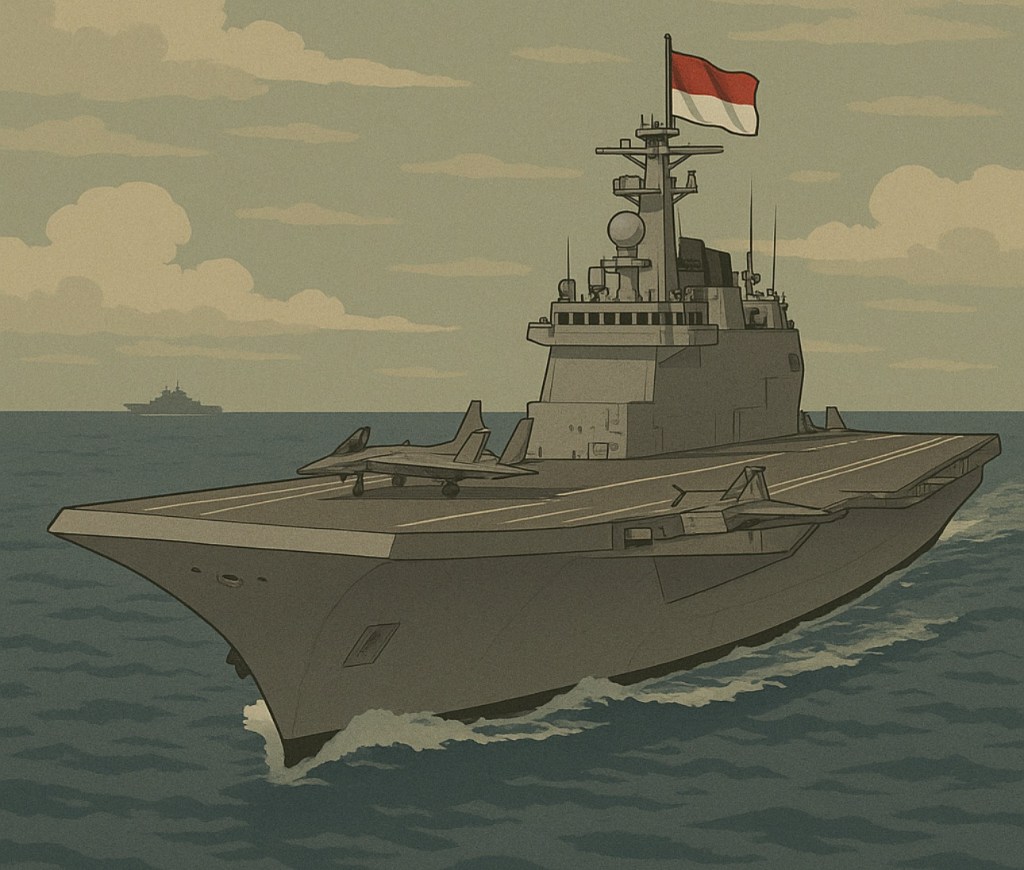
The discussion surrounding Indonesia’s potential acquisition of the Italian aircraft carrier Giuseppe Garibaldi has reawakened long-standing debates about maritime strategy, naval modernization, and the future of Indonesia’s defense identity as an archipelagic nation. The consideration of an aircraft carrier, the most powerful and symbolically charged instrument of sea power, has thrust Indonesia into the realm of strategic imagination traditionally reserved for global maritime powers. Whether the plan materializes or remains aspirational, it exposes a deeper question about Indonesia’s role in the Indo-Pacific order: is the country evolving toward a genuine blue-water navy capable of projecting power across oceans, or will it remain a predominantly littoral force focused on coastal defense and regional deterrence?
As a state defined by its maritime geography and strategic vulnerabilities, Indonesia’s aspiration to operate a carrier is both visionary and contentious. Proponents view it as the logical culmination of Indonesia’s naval modernization, a step toward realizing the doctrine of Poros Maritim Dunia (Global Maritime Fulcrum). Critics, however, warn that such ambitions risk overextension, diverting scarce resources from pressing needs such as submarine capability, fleet readiness, and human capital. The tension between aspiration and feasibility, symbolism and substance, defines the strategic significance of the aircraft carrier debate.
Maritime Identity and the Logic of Sea Power
Indonesia’s archipelagic character situates it at the heart of Alfred Thayer Mahan’s conception of maritime power. Control of sea lines of communication (SLOCs), the ability to project influence beyond territorial waters, and the integration of naval strength into national policy are central to maritime statecraft. Historically, Indonesia’s naval doctrine has oscillated between defensive coastal security and aspirations for blue-water capability. Since independence, the TNI Angkatan Laut (Indonesian Navy) has envisioned itself not merely as a guardian of sovereignty but as an instrument of regional influence and humanitarian diplomacy.
The aircraft carrier, in this context, symbolizes both technological progress and national prestige. Possession of a carrier signals a transformation from a brown-water navy, operating close to the shore, to a blue-water navy capable of sustained operations across the open sea. For Indonesia, such capability aligns with its geographical position astride vital maritime chokepoints, the Malacca, Sunda, and Lombok Straits, through which nearly half of global trade passes. An aircraft carrier would provide not only deterrence but also rapid humanitarian and disaster response capacity, reflecting the dual-use philosophy embedded in Indonesia’s defense doctrine.
Yet, maritime identity in Indonesia is not merely a function of hardware. It is rooted in cultural and historical consciousness. The memory of Majapahit’s maritime unity, the seafaring heritage of Bugis and Makassar, and Sukarno’s vision of Indonesia as a maritime civilization form the symbolic substratum for naval modernization. The debate over acquiring a carrier thus transcends military calculus; it becomes a contestation over how Indonesia envisions its destiny between land and sea.
Strategic Realism and the Debate over Capability
The prospect of acquiring the Giuseppe Garibaldi, a decommissioned Italian carrier with a displacement of around 14,000 tons, invites strategic reflection. Its potential use as a helicopter carrier or amphibious command ship would enhance Indonesia’s expeditionary and humanitarian capabilities rather than transforming the Navy into a fully fledged carrier strike force. Nonetheless, the operational, financial, and doctrinal implications remain significant.
From a realist perspective, Indonesia’s maritime threats remain asymmetrical rather than conventional. The main challenges derive from illegal fishing, piracy, territorial encroachment, and gray-zone operations, activities that require persistent surveillance, patrol capability, and maritime law enforcement. In this sense, the immediate utility of a carrier is limited compared to investments in submarines, maritime patrol aircraft, and integrated radar systems. However, strategic foresight dictates that deterrence is as much about perception as about parity. The symbolic acquisition of a carrier, even for limited use, could elevate Indonesia’s standing as a credible maritime actor capable of independent humanitarian operations and sea control in its Exclusive Economic Zone (EEZ).
The J-10 fighter acquisition for the Air Force and the discussion of a carrier for the Navy together reflect Indonesia’s gradual pursuit of joint-domain capability: air and sea integration within a single strategic ecosystem. This shift mirrors the modernization patterns of other regional powers, such as Japan’s conversion of Izumo-class destroyers and South Korea’s CVX program. While Indonesia’s version may begin modestly, it signals entry into a new level of maritime diplomacy, where capability equates to participation in shaping regional norms of presence and power.
Economic and Industrial Dimensions
The cost of acquiring, refitting, and maintaining an aircraft carrier poses the most tangible challenge. Naval economists estimate that sustaining even a light carrier could consume a disproportionate share of the defense budget if not aligned with industrial offsets and domestic co-production. The lesson from global experiences, ranging from the United Kingdom’s Queen Elizabeth-class to India’s Vikramaditya, underscores that carriers are as much industrial projects as military assets. For Indonesia, the viability of such an acquisition depends on how far it can integrate its domestic shipbuilding and maintenance industries under Defend ID into the project.
Indonesia’s shipyards, including PT PAL in Surabaya, have demonstrated increasing sophistication through projects such as the Makassar-class landing platform dock and the Merah Putih frigate program. If the carrier acquisition catalyzes technology transfer in propulsion, modular construction, or command systems, it could accelerate Indonesia’s naval industrial base. The economic spillover (employment, research, and education) would extend beyond defense to the wider maritime economy. However, without a clear industrial roadmap, the carrier could become an isolated prestige project disconnected from sustainable capacity building.
The question, therefore, is not merely whether Indonesia can afford a carrier, but whether it can afford not to develop the industrial ecosystem that such a program demands. True defense modernization lies in the capacity to transform defense investment into developmental capital, linking armament with innovation, and power projection with nation-building.
Geopolitical and Regional Ramifications
Regionally, the introduction of an Indonesian carrier would alter the psychological and operational balance within ASEAN. No Southeast Asian state currently operates a true aircraft carrier, though Thailand possesses the smaller HTMS Chakri Naruebet, used mainly for helicopter operations. Should Indonesia acquire the Giuseppe Garibaldi or a similar vessel, it would become the first Southeast Asian nation to possess a functional flat-deck capital ship with potential fixed-wing operations. This would elevate Indonesia’s maritime profile, allowing greater participation in multinational exercises, maritime security missions, and disaster relief operations across the Indo-Pacific.
At the same time, the geopolitical message must be carefully managed. The South China Sea remains a theater of tension, where symbols of military capability carry disproportionate political resonance. Indonesia’s non-claimant status gives it diplomatic flexibility, yet the presence of a carrier could be misinterpreted as a tilt in the regional balance. The key to mitigating this risk lies in doctrinal transparency: framing the carrier’s mission as one of “cooperative security,” for instance, through humanitarian and peacekeeping roles, rather than aggressive deterrence. This approach would align with ASEAN’s Outlook on the Indo-Pacific (AOIP), which emphasizes inclusivity and conflict prevention (ASEAN Secretariat, 2023).
Moreover, the carrier’s mobility could enhance Indonesia’s role in humanitarian assistance and disaster relief (HADR), a function of immense relevance given Indonesia’s location on the Pacific Ring of Fire. The vessel’s ability to carry helicopters, medical facilities, and supplies would transform the Navy into a first responder for regional disasters, strengthening Indonesia’s moral leadership as well as its strategic reach.
Naval Doctrine, Education, and Professionalism
Introducing a carrier requires a redefinition of naval doctrine and education. Carrier operations demand an ecosystem: trained deck crews, naval aviators, maintenance engineers, command systems, and air-defense integration. The TNI AL’s existing experience with amphibious operations and logistics ships offers a foundation, but the leap to carrier operations involves a qualitative transformation in mindset and management.
Institutions such as the Naval Command and Staff College (Seskoal) and the Naval Academy must therefore adapt their curricula to emphasize joint operations, maritime strategy, and technological literacy. The integration of carrier-based operations into Indonesia’s Total Defense System (Sishankamrata) framework would further align maritime modernization with national defense doctrine. The carrier, in this sense, would become both a classroom and a crucible, a tool for training the next generation of naval leaders capable of thinking operationally, strategically, and ethically.
Political Symbolism and National Identity
In the political imagination, an aircraft carrier is not merely a vessel, it is a floating symbol of sovereignty and confidence. For a nation that has long defined itself through its maritime geography, the prospect of such a ship evokes emotional resonance. It represents Indonesia’s emergence as a mature maritime nation, capable of defending its interests and contributing to regional order. This symbolism is especially potent within the Poros Maritim Dunia framework launched by President Joko Widodo, which seeks to reposition Indonesia as a central maritime actor bridging the Indian and Pacific Oceans.
Yet symbolism must be grounded in substance. The history of naval modernization in the developing world is replete with examples of aspirational projects that became fiscal liabilities or operational burdens. Indonesia must therefore navigate between grandeur and pragmatism—ensuring that prestige does not eclipse purpose. The carrier’s acquisition should serve as a platform for innovation and diplomacy, not as an end in itself.
Conclusion
The debate over Indonesia’s potential acquisition of the Giuseppe Garibaldi is ultimately a debate about national direction. It forces reflection on what kind of power Indonesia aspires to be in the twenty-first century: a continental state preoccupied with internal stability or a maritime nation asserting strategic agency in global affairs. The carrier, whether acquired or not, has already succeeded in reigniting discourse on maritime vision and defense integration.
If realized, the program could embody the synthesis of modernization, morality, and maritime identity that defines Indonesia’s evolving defense philosophy. If deferred, the debate itself remains valuable, stimulating public awareness and institutional learning about the costs, complexities, and opportunities of maritime statecraft. Either outcome, the issue underscores the enduring truth that for Indonesia, to command the sea is to command its destiny.
References
Aspinall, E., & Mietzner, M. (2022). Southeast Asia’s authoritarian turn revisited: Elite fragmentation and democratic decline in Indonesia. Journal of Contemporary Asia, 52(5), 710–728.
ASEAN Secretariat. (2023). ASEAN Political-Security Community Blueprint 2025: Mid-Term Review. Jakarta: ASEAN Secretariat.
Beeson, M. (2021). Middle Powers and the Rise of China. Palgrave Macmillan.
Bitzinger, R. A. (2016). Defense industries in the 21st century: A comparative analysis. Routledge.
Bueger, C., & Edmunds, T. (2023). Maritime security in the Indo-Pacific: The regionalization of the global commons. Marine Policy, 151, 105491.
Denhardt, J. V., & Denhardt, R. B. (2022). The New Public Service: Serving, not Steering (5th ed.). Routledge.
Drezner, D. W. (2023). The System Worked: Global Political Economy in the Post-Pandemic Era. Oxford University Press.
Edmunds, T. (2020). Security, Governance, and Military Capability: Integrating Armed Forces in the 21st Century. Routledge.
Ministry of Defense of Indonesia. (2023). Strategi Modernisasi Pertahanan Nasional 2020–2045. Jakarta: Kemhan RI.
Sukma, R. (2019). Indonesia and the Great Powers: Flexibility, Pragmatism, and Leadership in the Indo-Pacific. CSIS Indonesia.
 Pemikiran Kebangsaan
Leave a comment