By: Bangkit Rahmat Tri Widodo
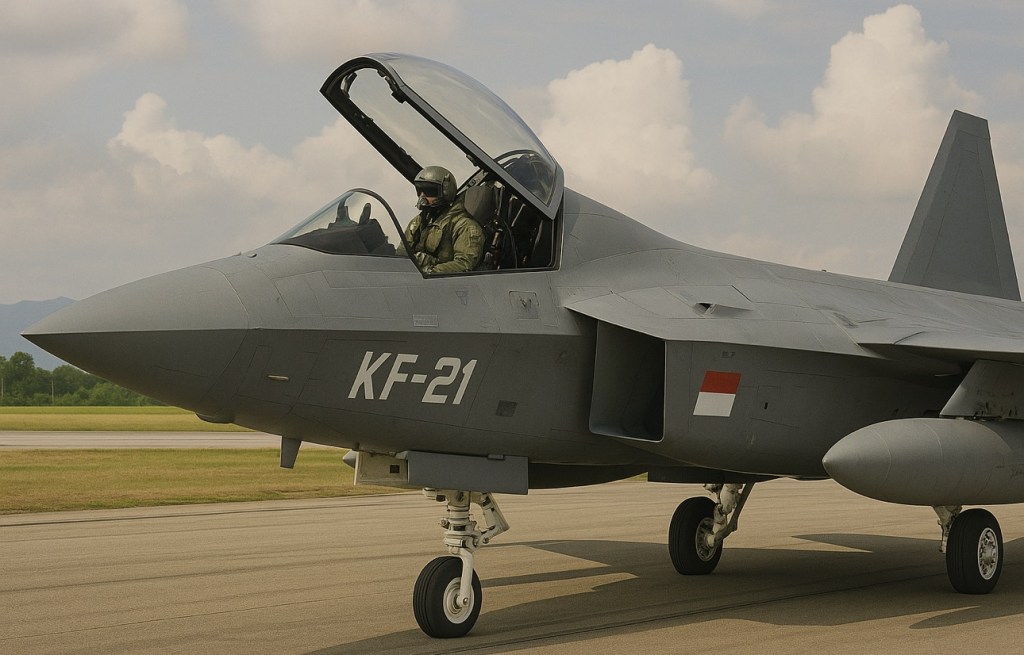
Indonesia’s engagement with the South Korean KF-21 Boramae and the Turkish KAAN fighter jet programs represents a crucial evolution in its pursuit of strategic autonomy and defense modernization. These cooperative ventures reflect more than the procurement of advanced weapon systems, they embody Indonesia’s vision to transform from a defense consumer into a defense co-producer. The trajectory of this collaboration must therefore be analyzed not solely through technological or financial metrics but as part of a broader narrative of national self-reliance, industrial learning, and geopolitical recalibration in an increasingly multipolar Indo-Pacific order.
The interdependence between interoperability and self-reliance, and the recognition that national defense capability is inseparable from national technological sovereignty. As major powers deepen their defense-industrial monopolies, Indonesia’s efforts to develop local participation in next-generation aircraft design signal a strategic determination to ensure that sovereignty in the twenty-first century is measured not merely by territory or resources but by mastery of innovation.
Indonesia’s Defense Modernization in Context
Since the early 2000s, Indonesia’s military modernization has been shaped by twin imperatives, restoring deterrence capability and achieving defense-industrial independence. The trauma of past embargoes, particularly the U.S. arms embargo from 1999 to 2005, left a lasting impression on Indonesia’s strategic thinking. It underscored the vulnerability of reliance on external suppliers and the political costs of dependency. The shift toward co-development arrangements such as the KF-21 partnership with South Korea is therefore not an accident of opportunity but a product of historical necessity (Sukma, 2019).
Indonesia’s defense policy now rests on three pillars: modernization, diversification, and industrialization. Modernization refers to upgrading operational capabilities to meet contemporary threats across air, sea, and cyber domains. Diversification involves sourcing equipment from multiple partners to avoid overreliance on any one power. Industrialization, however, is the long-term strategic foundation, transforming procurement into learning, and learning into innovation. Within this triad, participation in the KF-21 and potential cooperation with Turkey’s KAAN program embody Indonesia’s aspiration to bridge technological gaps through collaborative design, not passive acquisition.
The Geopolitics of Collaboration
The KF-21 Boramae project, a joint initiative between South Korea’s Korea Aerospace Industries (KAI) and Indonesia’s PT Dirgantara Indonesia (PTDI), began as a bold experiment in collaborative defense innovation among middle powers. The program’s rationale extended beyond technology, it sought to build a new model of South–South defense cooperation premised on equality and shared strategic interests. For Indonesia, the project offered a rare opportunity to internalize advanced aerospace knowledge, particularly in composite materials, avionics integration, and radar-absorption technology (Ministry of Defense of Indonesia, 2023).
However, cooperation in advanced defense industries is inherently complex. Cost-sharing disagreements, delays in Indonesia’s financial contributions, and political shifts in both Seoul and Jakarta occasionally strained the partnership. Yet the persistence of the program, culminating in Indonesia’s renewed commitment in 2025, reflects mutual recognition of its strategic value. The KF-21 is not simply an aircraft; it is a strategic bridge linking the defense industries of two dynamic middle powers in Asia, both seeking to reduce their dependency on the United States while maintaining cooperative alignment within the Western-led security architecture (Beeson, 2021).
Parallel to this, Turkey’s KAAN program has emerged as another locus of opportunity for Indonesia. The Turkish model of defense industrialization, marked by aggressive localization, modular production, and autonomous decision-making, resonates with Indonesia’s own vision of kemandirian pertahanan (defense self-reliance). As Turkey seeks export and co-development partners for its fifth-generation fighter, Indonesia’s inclusion would not only expand its technological exposure but also consolidate its role as a bridge between Asian and Middle Eastern defense ecosystems. This alignment reflects what Drezner (2023) calls adaptive alignment, a middle-power strategy that maximizes autonomy by forming flexible partnerships across multiple poles of power.
Interoperability and Self-Reliance: A Dual Paradigm
The conceptual tension between interoperability and self-reliance lies at the heart of Indonesia’s defense modernization. Interoperability demands that Indonesia’s military systems remain compatible with regional and allied partners to ensure operational integration in multinational contexts such as the ASEAN Defense Ministers’ Meeting Plus (ADMM-Plus). Self-reliance, conversely, demands technological independence and the capacity for sovereign maintenance, modification, and production. The challenge is reconciling these imperatives without compromising either.
In practical terms, Indonesia’s participation in the KF-21 and KAAN programs offers a mechanism for achieving both. Through shared design, simulation, and systems integration, Indonesian engineers gain exposure to global standards of interoperability while building indigenous capacity for manufacturing and systems maintenance. Over time, this dual exposure can lead to a hybrid defense model: interoperable in operation, independent in production. This balance mirrors Japan’s “dual-use” defense industrial policy and South Korea’s gradual evolution from license production to full innovation autonomy (Bitzinger, 2016).
However, achieving this balance demands sustained investment in human capital and institutional reform. Technical offsets and technology transfers can only bear fruit if domestic institutions possess absorptive capacity, skilled labor, research infrastructure, and policy continuity. The integration of defense education, such as PTDI’s collaboration with national universities and the Indonesian Defense University, forms the intellectual foundation for this transformation. The modernization of airpower thus becomes not merely a technological venture but a pedagogical revolution.
The Economics of Co-Development
The financial dimensions of the KF-21 and potential KAAN collaborations also reflect Indonesia’s evolving strategic economy. Defense co-development distributes cost, risk, and reward, offering fiscal efficiency while embedding learning opportunities. For Indonesia, which contributes around 20% of the KF-21 development budget, the return on investment lies not only in aircraft acquisition but in knowledge assimilation. The production of airframes, subsystems, and software within domestic facilities represents a form of national capital accumulation in high-technology industries.
Nevertheless, co-development carries economic vulnerabilities. Currency fluctuations, changing political priorities, and competing budgetary pressures can undermine continuity. The challenge for Indonesia is to insulate long-term defense programs from short-term fiscal cycles. This requires institutionalizing defense investment as a component of industrial strategy rather than discretionary expenditure. When embedded within the National Long-Term Development Plan (RPJPN), defense innovation becomes part of Indonesia’s structural transformation toward a knowledge-based economy, a direction consistent with the “Defense by Development” paradigm.
Regional and Strategic Implications
The implications of Indonesia’s engagement in next-generation fighter programs extend beyond national defense. In the regional context, it signals ASEAN’s gradual shift toward indigenous defense production and reduced dependence on external suppliers. While individual ASEAN states vary widely in capacity, Indonesia’s progress may encourage collective initiatives in defense industrial collaboration, echoing the European experience of cooperative armament development (ASEAN Secretariat, 2023).
At the strategic level, Indonesia’s alignment with South Korea and Turkey diversifies the Indo-Pacific’s defense-industrial geography. It introduces a “third vector” in a region long dominated by U.S. and Chinese technological ecosystems. This diversification enhances resilience and promotes multipolar equilibrium, a condition in which small and middle powers possess enough autonomy to shape regional norms. Indonesia’s choice of partners, both non-Western yet technologically capable, demonstrates strategic creativity: leveraging partnerships outside the binary logic of great-power competition to advance its own agenda of sovereignty and development.
Challenges of Technological Sovereignty
While the vision of defense self-reliance is compelling, the path is strewn with structural challenges. Technology transfer agreements often face restrictions related to intellectual property rights and export controls. Even within cooperative frameworks, foreign partners may retain control over critical subsystems such as radar algorithms, engine designs, or electronic warfare software. These “black boxes” limit true autonomy. Overcoming this barrier requires Indonesia to develop niche expertise, areas such as maintenance software, composite materials, or mission-data programming, where incremental innovation can accumulate into genuine independence over time.
Moreover, the sustainability of the KF-21 and KAAN partnerships depends on domestic political stability and bureaucratic coherence. Defense-industrial policy in Indonesia is often fragmented among ministries and agencies, each with distinct priorities. Establishing a permanent inter-ministerial defense-industrial council could help synchronize investment, research, and education. Without such institutional coherence, even advanced collaborations risk stagnation.
A Vision for 2045: Toward Strategic Self-Reliance
Indonesia’s centennial vision, Visi Indonesia Emas 2045, envisions the nation as a sovereign, advanced, and globally respected power. Defense self-reliance forms one of its strategic pillars. The KF-21 and KAAN programs, therefore, are not isolated procurement ventures but stepping-stones toward realizing that vision. They embody what can be termed technological sovereignty: the ability to control critical technologies essential for national defense, while maintaining openness to cooperation and learning.
By 2045, Indonesia aims not only to operate modern systems but to design, produce, and export defense products. Achieving this goal requires sustained investment in research ecosystems, talent cultivation, and international partnerships that emphasize equality and reciprocity. The collaboration with South Korea and Turkey thus becomes a template for future engagements, with Japan, France, or even regional partners within ASEAN, based on shared innovation rather than dependency.
Conclusion
Indonesia’s participation in the KF-21 and KAAN fighter programs represents a strategic inflection point in its journey toward defense autonomy. It bridges aspiration and pragmatism, symbolism and substance. Through these collaborations, Indonesia is asserting a new model of statecraft, one that redefines sovereignty in terms of knowledge, industry, and strategic cooperation.
The long-term success of these initiatives will depend not only on technology but on governance, education, and vision. If Indonesia can sustain coherence between industrial policy, defense diplomacy, and national innovation, it may well emerge as a model for middle powers seeking autonomy amid great-power rivalry. In that sense, the KF-21 and KAAN are not merely aircraft, they are metaphors for Indonesia’s flight toward technological nationhood, a trajectory in which power and independence ascend together.
References
ASEAN Secretariat. (2023). ASEAN Political-Security Community Blueprint 2025: Mid-Term Review. Jakarta: ASEAN Secretariat.
Beeson, M. (2021). Middle Powers and the Rise of China. Palgrave Macmillan.
Bitzinger, R. A. (2016). Defense industries in the 21st century: A comparative analysis. Routledge.
Drezner, D. W. (2023). The System Worked: Global Political Economy in the Post-Pandemic Era. Oxford University Press.
Edmunds, T. (2020). Security, Governance, and Military Capability: Integrating Armed Forces in the 21st Century. Routledge.
Ministry of Defense of Indonesia. (2023). Strategi Modernisasi Pertahanan Nasional 2020–2045. Jakarta: Kemhan RI.
Sukma, R. (2019). Indonesia and the Great Powers: Flexibility, Pragmatism, and Leadership in the Indo-Pacific. CSIS Indonesia.
 Pemikiran Kebangsaan
Leave a comment